Making advanced AI development more accessible to businesses
ENACT AI
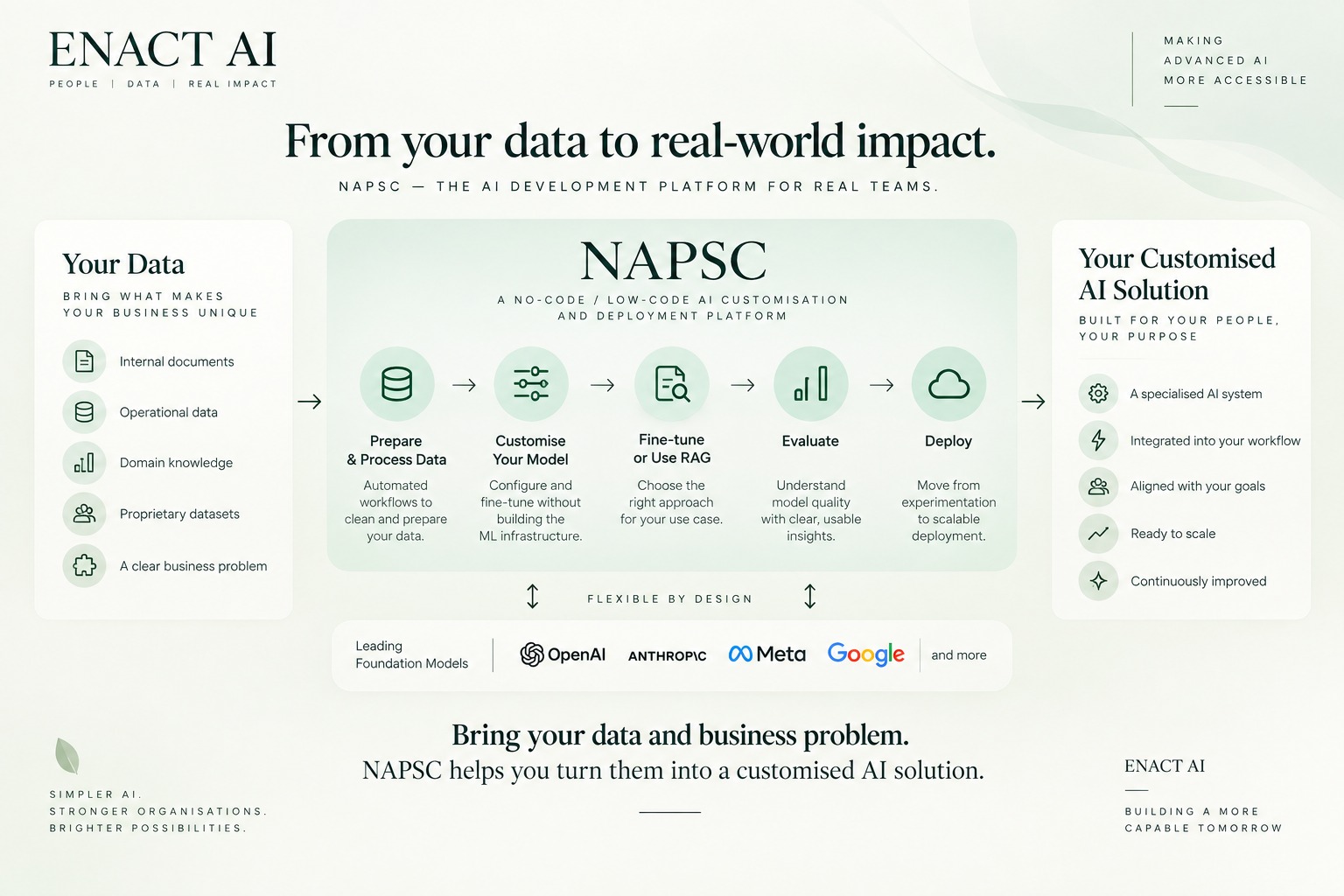
NAPSC is the flagship platform behind ENACT AI. It is a no-code/low-code AI customisation and deployment platform designed for organisations that have valuable data and a clear AI use case but do not have large in-house machine learning teams.
- AI Platform
- No-code / Low-code
- Product Strategy
- Market Research
- Discovery
Project overview
- Project
- ENACT AI, and its flagship platform NAPSC
- Product type
- No-code / low-code AI customisation and deployment platform
- Context
- Product management role
- My role
- Product Manager
- My work
- Product Management · Product Strategy · AI Product Development · Market Research · Discovery
01
The Problem
Businesses want to use AI. Building it is another matter.
For many startups, SMEs and specialist organisations, adopting advanced AI means dealing with significant barriers.
Technical complexity
Building and maintaining machine learning infrastructure requires specialist expertise.
Data preparation
Proprietary business data often needs substantial preparation before it can be used effectively with AI models.
Development cost
Creating custom AI systems from scratch can require significant engineering resources.
Specialist expertise
Many organisations have valuable data and strong use cases but lack dedicated machine learning teams.
The opportunity behind NAPSC was to reduce this complexity and make the path from business data to a usable AI system more accessible.
02
The Product
From proprietary data to a customised AI solution.
NAPSC is designed to guide organisations through the AI development lifecycle in a no-code/low-code environment.
The AI development workflow
Business data
Prepare and process data
Choose an AI approach
Fine-tune model or use RAG
Evaluate
Deploy
Monitor and improve
Bring your data and business problem. NAPSC helps turn them into a customised AI solution.
03
Product Capabilities
Data preparation
Automated workflows to help prepare proprietary business data for AI use.
Model customisation
Support for configuring and fine-tuning models without requiring users to build the underlying ML infrastructure themselves.
RAG
Support for retrieval augmented generation where connecting a model to proprietary knowledge is more appropriate than fine-tuning.
AI guidance
Guidance through the development process to make sophisticated AI workflows easier for non-specialist teams to understand.
Model evaluation
Tools for evaluating model performance and helping users understand model quality.
Deployment
A path from experimentation and customisation towards scalable deployment.
Configurable development paths
Different workflows depending on the organisation's data, use case and chosen AI approach.
Future platform opportunity
Future conceptPotential expansion into an AI tools or model marketplace. This is a future concept rather than functionality that was built.
Items marked as future concepts were part of the platform's longer-term direction rather than functionality presented as shipped.
04
A Key Product Decision
Fine-tuning isn't always the answer.
One important product consideration was avoiding the assumption that every proprietary AI use case requires model fine-tuning. The platform concept considered both fine-tuning, for cases where adapting model behaviour is appropriate, and retrieval augmented generation, for cases where organisations primarily need an AI system to work with their proprietary knowledge.
Business problem
Fine-tuning
Adapting model behaviour to the organisation.
RAG
Connecting a model to proprietary knowledge.
Customised AI solution
The technology should follow the use case, rather than forcing every customer through the same AI development path.
05
Who It Is For
AI capability without an entire ML department.
Startups
SMEs
Specialist organisations
Operational teams
Particularly organisations that have valuable proprietary data, a defined AI use case and limited internal ML infrastructure. NAPSC was not positioned as simply AI for everyone.
06
Market Entry
Start focused, then expand.
Rather than attempting to serve every industry immediately, the initial market strategy identified renewable energy as a potential entry vertical. This created an opportunity to explore industry-specific workflows and templates rather than expecting every customer to configure an AI system from scratch.
Strategic direction, not achieved expansion
Renewable energy
Industry-specific AI workflows
Validate the platform approach
Potential expansion
Manufacturing · Industry 4.0 · other specialist sectors
07
Product Principle
Hide the infrastructure complexity, not the important decisions.
NAPSC is intended to make sophisticated AI development more accessible while still giving organisations visibility and control over how their data, models and evaluation processes are handled.
08
Making AI Evaluation Understandable
Another product challenge was how to expose sophisticated machine learning concepts to users who may not be ML specialists.
Model evaluation could include technical measures such as perplexity, but the product experience needed to translate model quality into information users could understand and act on. I treated this as a product and user experience problem rather than a case of presenting technical metrics without context.
09
The Platform Opportunity
Company data + business problem
NAPSC
- Data preparation
- AI guidance
- Model customisation / RAG
- Evaluation
- Deployment
Specialised AI application
Business workflow
NAPSC sits between an organisation's proprietary data and the underlying AI models, rather than being another interface on top of a single model.
10
Why This Matters
ENACT AI is not simply another application built on top of a single AI model. The product opportunity is the workflow and infrastructure layer that helps organisations move from proprietary data and a business problem to a specialised AI system without having to build the entire machine learning stack internally.
The bigger product question
How much of AI development can we make accessible without hiding the decisions that genuinely matter?
That is the product challenge at the centre of NAPSC.